Family AsteraceaeAchillea ptarmica L.sneezeweed, sneezewortAchillea: named for Achilles, who supposedly used plants of the genus to staunch the wounds of his soldiers at the siege of Troyptarmica: Greek ptario for "to sneeze
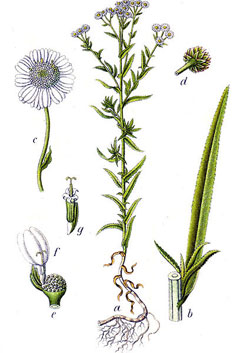
Achillea ptarmica (sneezewort, sneezeweed, bastard pellitory, European pellitory, fair-maid-of-France, goose tongue, sneezewort yarrow, wild pellitory, white tansy) is a species of herbaceous perennial flowering plant in the genus Achillea. It has loose clusters of white, button-like flowers that bloom from June to August. Its dark green leaves have finely toothed margins.
The name ptarmica comes from the Greek word ptairo (=sneeze) and means 'causes sneezing'. The name "yarrow" applies specifically to varieties of A. millefolium,[1] but is often confusingly used for other species within the genus - including A. ptarmica.
Like many other plants, the sneezewort's pattern of development displays the Fibonacci sequence.[
|
Click on the image below to enlarge it and download a high-resolution TIFF file.

Britton, N.L., and A. Brown. 1913. An illustrated flora of the northern United States, Canada and the British Possessions. 3 vols. Charles Scribner's Sons, New York. Vol. 3: 515. Courtesy of Kentucky Native Plant Society. Scanned by Omnitek Inc. Usage Requirements. |
Uses:
Leaves can be eaten raw or cooked. Leaves are Cardiac; Diaphoretic; Digestive; Emmenagogue; Odontalgic; Sternutatory; Styptic. The leaf is chewed to relieve toothache. The dried, powdered leaves are used as a sneezing powder. Yields an essential oil that is used medicinally. The leaves are used as an insect repellent.[
The plant is poisonous to cattle, sheep, and horses. Symptoms are generally slow to develop, and include fever, rapid pulse, difficulty breathing, weight loss, drooling, spasms and loss of muscular control, and convulsions.
Cultivation:
This is a hardy, drought-tolerant plant that prefers full sun and moist but well-drained soil. Propagation is by sowing seed or division in Spring. Numerous cultivars have been selected for garden use, including 'The Pearl' (a clonal variety)[4] and 'Aunt Stientje'.[5] Both have gained the Royal Horticultural Society's Award of Garden Merit.

| Edible Uses |
|
Edible Parts: Leaves.
Edible Uses:
Leaves - raw or cooked[17, 105, 177]. Used as a flavouring in salads[172]. | |
|
|
|
| Other Uses |
Essential; Hair; Miscellany; Repellent.
The dried, powdered leaves are used as a sneezing powder[61, 100]. Yields an essential oil that is used medicinally[100]. The report does not say what part of the plant the oil is obtained from, it is most likely to be the leaves harvested just before flowering[K]. The leaves are used as an insect repellent[172]. | |
| Cultivation details |
|
| Succeeds in most soils but prefers a moist well-drained soil in a sunny position[1, 187]. Plants also succeed in partial shade[187]. Plants succeed in maritime gardens[233]. They live longer when growing in a poor soil[200]. The plant has a spreading root system and can be very invasive[233]. Hardy to at least -25°c[187]. There are some named varieties, selected for their ornamental value[233]. Hybridizes freely with other members of this genus[200]. | |
| |
|
| Propagation |
|
| Seed - sow spring or early autumn in a cold frame[133]. The seed usually germinates in 1 - 3 months[133]. When large enough to handle, prick the seedlings out into individual pots and plant them out in the summer. Division in spring or autumn. Very easy, the divisions can be planted direct into their permanent positions. Basal cuttings of new shoots in spring. Very easy, collect the shoots when they are about 10cm tall, potting them up individually in pots and keeping them in a warm but lightly shaded position. They should root within 3 weeks and will be ready to plant out in the summer. |
|
| Edible Uses |
|
Edible Parts: Leaves.
Edible Uses:
Leaves - raw or cooked[17, 105, 177]. Used as a flavouring in salads[172]. | |
|
|
|
| Other Uses |
Essential; Hair; Miscellany; Repellent.
The dried, powdered leaves are used as a sneezing powder[61, 100]. Yields an essential oil that is used medicinally[100]. The report does not say what part of the plant the oil is obtained from, it is most likely to be the leaves harvested just before flowering[K]. The leaves are used as an insect repellent[172]. | |
| Cultivation details |
|
| Succeeds in most soils but prefers a moist well-drained soil in a sunny position[1, 187]. Plants also succeed in partial shade[187]. Plants succeed in maritime gardens[233]. They live longer when growing in a poor soil[200]. The plant has a spreading root system and can be very invasive[233]. Hardy to at least -25°c[187]. There are some named varieties, selected for their ornamental value[233]. Hybridizes freely with other members of this genus[200]. | |
| |
|
| Propagation |
|
| Seed - sow spring or early autumn in a cold frame[133]. The seed usually germinates in 1 - 3 months[133]. When large enough to handle, prick the seedlings out into individual pots and plant them out in the summer. Division in spring or autumn. Very easy, the divisions can be planted direct into their permanent positions. Basal cuttings of new shoots in spring. Very easy, collect the shoots when they are about 10cm tall, potting them up individually in pots and keeping them in a warm but lightly shaded position. They should root within 3 weeks and will be ready to plant out in the summer. |
|


| Edible Uses |
|
Edible Parts: Leaves.
Edible Uses:
Leaves - raw or cooked[17, 105, 177]. Used as a flavouring in salads[172]. | |
|
|
|
| Other Uses |
Essential; Hair; Miscellany; Repellent.
The dried, powdered leaves are used as a sneezing powder[61, 100]. Yields an essential oil that is used medicinally[100]. The report does not say what part of the plant the oil is obtained from, it is most likely to be the leaves harvested just before flowering[K]. The leaves are used as an insect repellent[172]. | |
| Cultivation details |
|
| Succeeds in most soils but prefers a moist well-drained soil in a sunny position[1, 187]. Plants also succeed in partial shade[187]. Plants succeed in maritime gardens[233]. They live longer when growing in a poor soil[200]. The plant has a spreading root system and can be very invasive[233]. Hardy to at least -25°c[187]. There are some named varieties, selected for their ornamental value[233]. Hybridizes freely with other members of this genus[200]. | |
| |
|
| Propagation |
|
| Seed - sow spring or early autumn in a cold frame[133]. The seed usually germinates in 1 - 3 months[133]. When large enough to handle, prick the seedlings out into individual pots and plant them out in the summer. Division in spring or autumn. Very easy, the divisions can be planted direct into their permanent positions. Basal cuttings of new shoots in spring. Very easy, collect the shoots when they are about 10cm tall, potting them up individually in pots and keeping them in a warm but lightly shaded position. They should root within 3 weeks and will be ready to plant out in the summer. |
|



 Plant Suppliers: Click here for a


